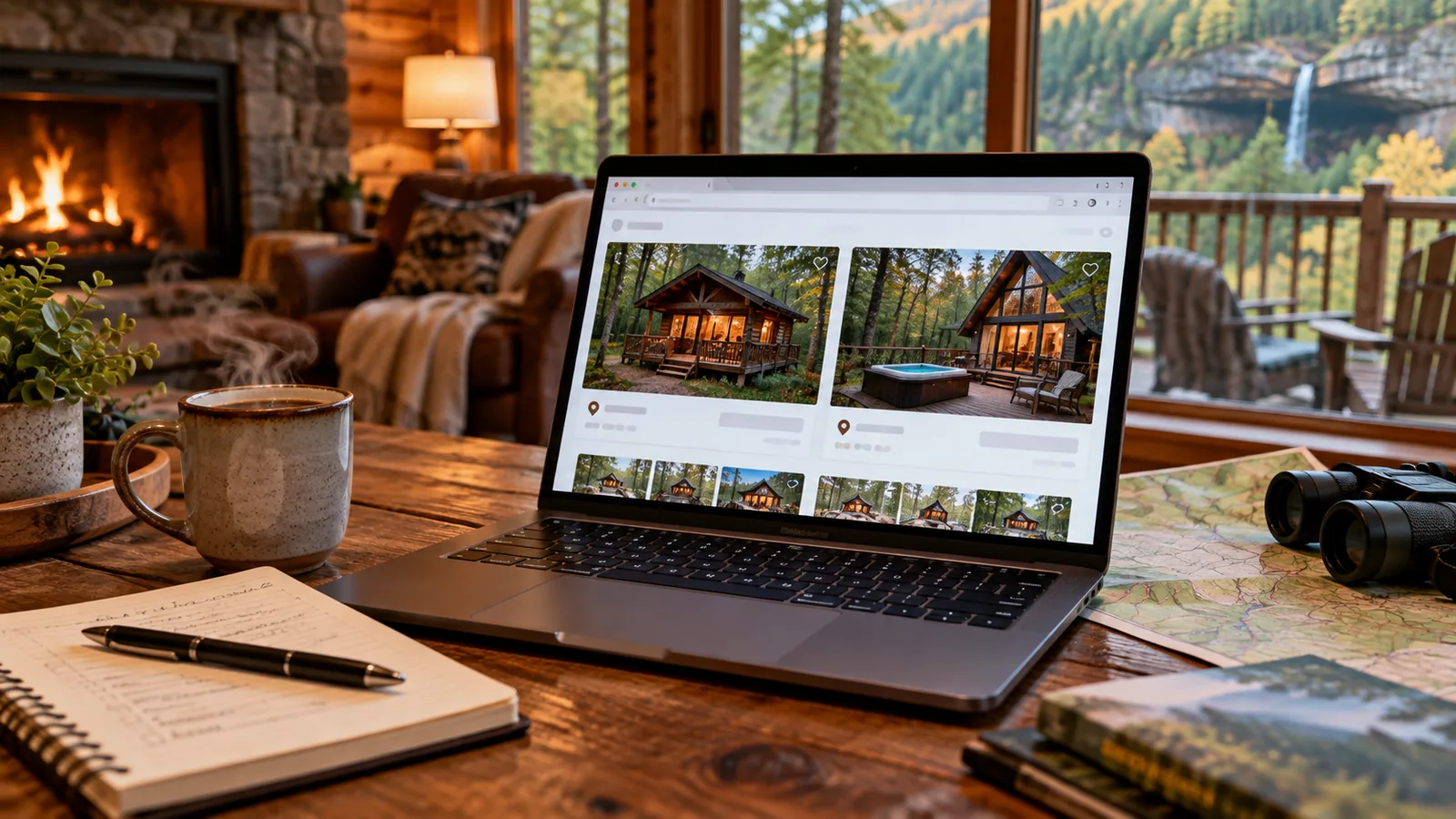
One large cabin is not always the best answer for a family reunion. Some families want separate quiet spaces for grandparents and young children. Others need extra bathrooms, pet-friendly accommodations, or two kitchens because meals happen on different schedules. Two nearby cabins can solve those problems—but only if the properties are truly close and their rules work together.
In Hocking Hills, “nearby” should be treated as a question, not a promise. Two listings may use the same regional name while being farther apart than a group wants to drive. Before you pay for either property, you need a plan for how everyone will sleep, gather, park, eat and respond when plans change.
Start with the reunion’s real shape
Write down the entire traveling group, separated by households or the people who naturally want to share a room. Count adults, children, infants and pets. Identify any guests who need a first-floor bedroom, an accessible bathroom, a quieter environment or more privacy. Ask how many people want a private room and how many are comfortable with bunk beds or sofa beds. There is no need to collect sensitive medical details; practical access requirements are enough for the first inquiry.
Next decide whether the group plans to spend most of the day together or simply wants to stay in the same area while taking separate outings. This choice changes what matters. A reunion with communal dinners needs one gathering space big enough for everyone, and the property’s guest policy must allow people sleeping elsewhere to visit. Two cabins with six bedrooms total may still be a poor fit if neither dining room can seat the full group.
What “nearby” should mean on a map
Ask for a realistic drive-time range between the properties, not just a straight-line distance. Request actual addresses or reliable map pins once the operators are willing to share them as part of booking. Some rural routes may be slow, narrow, winding or less comfortable after dark. Check the intended route for the type of vehicle your group will use, and ask about winter conditions if the reunion falls in a colder month.
Set a maximum separation before searching. For some groups, a short walk within the same property is ideal. For others, a drive of several minutes is manageable. The right number depends on mobility, weather, children, and how often people expect to move between cabins. What does not work is discovering after check-in that “adjacent cabins” meant properties on opposite sides of a busy route.
If a listing claims two cabins are on the same property or managed together, ask whether they can be booked simultaneously and whether the spaces, driveways, fire pits or outdoor amenities are shared. Clarify whether each cabin has its own entrance and parking. Shared management can make coordination easier, but does not guarantee one contract or a single refund policy.
Identify the main gathering cabin
Choose one cabin as the default location for communal meals and group activities. Confirm its maximum permitted occupancy, including daytime visitors who sleep at the second property. Some vacation rentals have strict visitor caps, event restrictions or separate rules for gatherings. Do not assume that a permitted overnight group of ten can host fifteen people for dinner without the owner’s written approval.
Check the actual number of chairs and usable dining surfaces. A listing’s “sleeps 12” badge says almost nothing about seating. Ask about cookware, refrigerator size, available serving space and whether extra tables are allowed. If the group wants catering, request the owner’s policy on outside vendors and parking rather than treating a catered dinner as an ordinary meal by default.
For outdoor gathering, ask about deck size, lighting, steps, seating, noise restrictions, fire pit rules and whether amenities are accessible during your dates. A shared evening is pleasant only if it respects safety requirements and the host’s conditions. Do not make assumptions about using hot tubs, pools or other amenities across property lines.
Give each household a sleeping plan
Create a simple room chart showing each cabin, each bedroom, bed size, bathroom availability and proposed household assignment. A “four-bedroom” listing may include a loft counted differently, a bedroom reachable only by stairs, or a bunk room better suited to children than adults. Ask for floor plans or recent photographs if the configuration is unclear. If someone must use a first-floor bathroom at night, verify its actual placement.
Separate must-haves from preferences. A first-floor sleeping arrangement can be essential. A particular décor style probably isn’t. Clarify whether cribs, high chairs and other children’s equipment are provided; do not assume photos of family-oriented cabins establish those items. If a pet is joining, verify breed or size rules, additional fees and where pets may be left unattended.
Compare one combined budget, not two nightly rates
Each cabin may have its own nightly charge, minimum stay, cleaning fee, pet fee, security deposit, taxes and cancellation terms. Put them on separate lines and calculate a combined total for matching dates. Ask whether splitting the reservation across properties changes charges or whether a multi-property discount is available—but never assume there is one.
Do not forget practical costs: travel between cabins, groceries for communal meals, accessible transport, equipment rentals and a contingency if one household arrives late. For transparency, record who pays each property deposit and how each family reimburses that person. A useful arrangement is one written group budget with receipts attached, rather than a mix of informal payment requests.
Decide up front what happens if a relative cancels. Will the group divide the remaining costs differently? Does everyone pay a nonrefundable share once the booking becomes nonrefundable? These are family decisions; spell them out kindly before collecting money. The operator’s refund rules still control the property reservation.
Coordinate bookings so one confirmation does not strand the other
Two separate listings create a timing problem: one can be available while the other is held by another traveler. Before paying, ask each operator whether a brief, documented hold is possible, what payment is needed to confirm, and whether the reservation can be canceled if the paired property becomes unavailable. Get the rules in writing. Avoid a nonrefundable booking for the first cabin before checking the second.
If one operator manages both cabins, request one document listing the exact properties, dates, guest limits, prices, deposits, and separate or combined cancellation conditions. If different owners are involved, keep two confirmations and do not imply that one is responsible for the other’s promises.
A safety and logistics meeting that lasts ten minutes
Once the cabins are confirmed, share check-in instructions with the adults who need them. Identify a primary contact for each house. Agree on where the group will meet on arrival, where vehicles will park, and how children will be supervised around outdoor amenities. If mobile coverage or Wi-Fi is uncertain, have an offline plan for contacting people and finding the properties.
Ask the operators about winter road access, snow or ice procedures when relevant, emergency contact numbers, fire safety and the location of basic safety equipment. Those questions are relevant in rural accommodation without requiring anyone to predict weather or promise uninterrupted access. For guests with mobility needs, confirm exterior steps, bathroom setup and nighttime lighting before departure.
Check the rules that differ between the two cabins
Quiet hours may begin at different times. One property may prohibit day visitors while the other allows them with approval. Hot tub rules, minimum guest age, smoking, pets, fire pits, parking and checkout times can also differ. Copy the important conditions into one group message so people do not treat both properties as interchangeable. A good family reunion is one where visitors and hosts know what was agreed.
If the group wants music or a catered celebration, disclose that plan during the inquiry. Do not label a private event a simple family dinner to evade property rules. There may be a suitable venue or rental arrangement for that gathering even if an ordinary cabin cannot accommodate it.
A two-cabin inquiry template
Hello! We are planning a Hocking Hills family reunion for [dates] with [total guests] across [households]. We are looking for two cabins close to each other, ideally within [maximum drive time]. We need [number] bedrooms and [requirements such as first-floor access, pet policy or separate kitchens]. We would like to gather for meals at one cabin. Can you confirm whether daytime visitors from the second cabin would be permitted, what the actual distance is, and the combined total price and cancellation terms for both properties?
You can send this to operators with multiple properties or ask a cabin-matching service to identify possible pairs. Do not share sensitive personal details about guests unless required for a legitimate booking or accessibility arrangement.
What matters when choosing the final pair
Use three filters in order. First, feasibility: both properties are available for identical dates, have acceptable occupancy rules and meet nonnegotiable access needs. Second, coordination: they are close enough and one can legally host the planned group activities. Third, value: the combined all-in price, amenities and cancellation conditions make sense for the families paying.
If no pair meets all three, consider one different large cabin, changing the dates or choosing a group-friendly venue. It is better to adjust the plan than to book two incompatible properties under pressure.
Your next step
HockingCabins can help you organize a request that gives owners the information they need to assess two-property options: dates, group size, room layout, budget, pet needs and gathering expectations. Exact inventory, distances, visitor rules and prices must be confirmed with the relevant operators before booking. A few precise questions early can save a family from complicated check-in day surprises.
Editorial note: No specific cabin, owner, availability or distance is endorsed or verified by this guide.
Cabin availability, nightly rates, property rules and amenities must be confirmed directly with the operator before booking.